Summer 2026
The Wizard of Oz
A Groundbreaking Classic
Read this article in flipbook view
Everyone knows the music from The Wizard of Oz, up to a point. “Over the Rainbow,” the heart-tugging musical dream of a faraway land of beauty and contentment, became a classic of the American songbook almost as soon as the film was released in 1939 and has never faded from the cultural landscape. The parallel trio of songs for Dorothy’s companions on the Yellow Brick Road, which use the same melody to voice a desire for a brain, a heart, or “the nerve,” respectively, are also familiar to anyone steeped in the film since childhood.
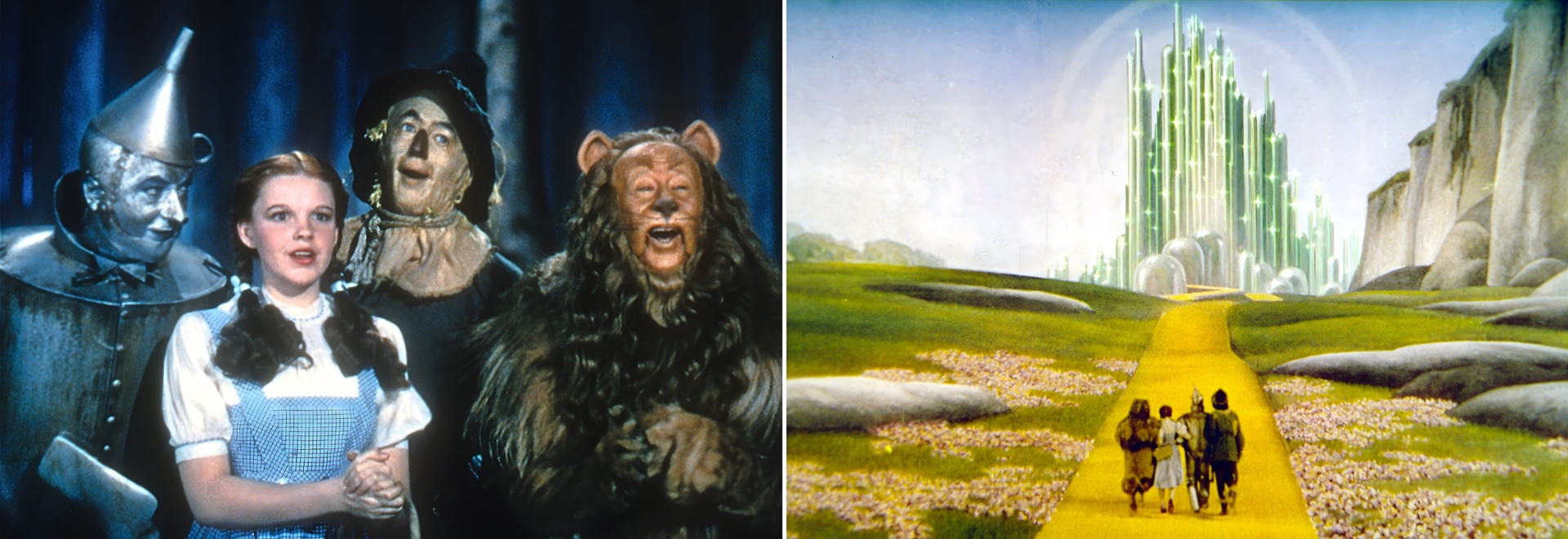
In between those recognizable landmarks, though, lies a great treasure house of orchestral music — by turns tender and ferocious, emphatic and reserved — that moviegoers don’t often take the opportunity to savor. “There is absolutely gorgeous music, there is exciting music,” says Ming Luke, who conducts the Festival’s presentation of The Wizard of Oz with live orchestral accompaniment. “The music is just what we want it to be: another character in the film.”
To hear Luke tell it, conducting a live orchestra to match the exact pacing of an existing film is a complicated undertaking. The video monitor on his podium displays the score, which scrolls in real time with the movie. It also offers him a display of the movie itself. Each of these displays is loaded with detailed markings — lines, circles, and elaborately color-coded dots — to help him keep everything perfectly in sync.
The danger, Luke says, comes when his efforts to maintain perfect alignment between the film and the orchestra threaten to occupy all his attention. “Suddenly, any artistic sensibilities sort of dissipate. For a conductor on this kind of project, one of your major tasks is to make sure the music remains artistically sensible. In an orchestral concert, if the tempo slows down, there’s a reason why that’s happening, and it’s the conductor’s job to make that reason clear to the audience. I have to do the same thing here.”
Artistic logic is particularly important for The Wizard of Oz score, if only because it’s such a fine example of the work emerging from the music departments of Hollywood during the heyday of the studio system. The songs — including, in addition to those already mentioned, such beloved earworms as “Ding-Dong! The Witch is Dead!” and “The Merry Old Land of Oz” — are the work of composer Harold Arlen and lyricist E.Y. “Yip” Harburg, two of the most inventive songwriters of the 20th century. Everything in between was the handiwork of composer and conductor Herbert Stothart, who spent the last 20 years of his life on the MGM music roster and won an Academy Award for Best Original Score for The Wizard of Oz.
"The music is just what we want it to be: another character in the film"
Unfortunately, not much of that prizewinning score has survived. A presentation like the current one required the efforts of John Wilson, who, in addition to his career as a top classical conductor, has a sideline in restoring scores from the MGM library; to date, he’s restored about 350 sets of song-and-dance routines. For The Wizard of Oz, he and his colleague Andrew Cottee set to work at opposite ends of the soundtrack — one working forward from the beginning, the other backwards from the end — until they met in the middle.
The materials they had to work with were meager, primarily fragmentary piano reductions of varying levels of detail. “Sometimes it seems to have boiled down to who was the music copyist on some particular morning in 1938,” he says. For the rest, the two collaborators had to listen carefully to the soundtrack and transcribe what they heard.
Some of it was punishing, such as the music for the famous cyclone scene. “That music is as detailed as something by Ravel or Puccini or Mahler,” Wilson says. “It's fully organized orchestral music in a highly Romantic, chromatic idiom, so it's not something you can do quickly. Often, we could only manage 8 or 10 measures in a day.”
As Wilson sees it, there’s no fundamental difference between a film score of the 1930s and an orchestral score that you might encounter in a concert hall. “This music is part of the melting pot that includes Stravinsky, Debussy, and other composers who were just the kind of established modernism of the time. And I believe that the best of these pieces will last. The Wizard of Oz, in its own way, is a little masterpiece.”