Summer 2026
Judgment of Paris
From Mount Olympus to Napa

Read this article in flipbook view
The story of The Judgment of Paris reaches deep into myth and history. It begins at a wedding feast to which every god of Olympus was invited, except one: Eris, the goddess of discord. After all, who wants discord at a celebration of love? Furious at being excluded, Eris tossed a golden apple into the crowd of goddesses, inscribed with the words “To the Fairest.”
Three of the most beautiful goddesses — Aphrodite, Hera, and Athena — claimed the prize and demanded that Zeus decide. But Zeus wanted no part in this. So he sent for Paris of Troy and charged him with choosing the rightful recipient.
Each goddess offered Paris a bribe: Hera promised him dominion and power, Athena the gift of wisdom, and Aphrodite the love of the world’s most beautiful woman, Helen.
Paris chose love over wisdom or power, awarded the golden apple to Aphrodite, and set sail with his new amour, Helen. This led to the Trojan War and eventually the fall of Troy, an outcome aided and abetted by the wrath of the goddesses spurned by the Judgment of Paris.
"“Nothing more excellent or valuable than wine was ever granted by the gods to man.” - Plato
Fast forward to May 1976 in Paris, and the gods and goddesses were at it again. At the Hotel Intercontinental, a wine tasting was about to begin. It was organized by British wine merchant Steven Spurrier and his American colleague Patricia Gallagher to celebrate Franco-American friendship in the U.S. bicentennial year. They invited nine of France’s foremost wine experts to judge ten white and ten red wines, renowned Burgundian Chardonnays and Bordeaux blends set against little-known bottles from California. And in the purest spirit of liberté, égalité, fraternité, the wines were tasted blind.
The outcome seemed preordained: France, the center of the wine universe, would easily triumph.
 Until the unimaginable happened.
“This is definitely California. It has no nose,” one judge proclaimed, unaware he was tasting a Bâtard-Montrachet, one of Burgundy’s finest. Another took a sip of a 1972 Napa Chardonnay and sighed, “Ah, back to France.”
This time, the golden apple went to Napa Valley. The 1973 Chateau Montelena Chardonnay, crafted by winemaker Mike Grgich, and Warren Winiarski’s 1973 Stag’s Leap Wine Cellars Cabernet Sauvignon, took top honors. Other Napa Valley wineries, including Freemark Abbey, Clos du Val, and Spring Mountain Vineyard, also scored highly.
George Taber, the only journalist present, captured the shock in Time magazine under the headline “Judgment of Paris,” writing that “California defeated all Gaul.”
The impact was seismic. The tasting catapulted Napa Valley onto the world stage and dispelled the belief that excellence in winemaking, or in any art, was the exclusive domain of the Old World. It was a cultural awakening, a moment when tradition met innovation on equal ground.
The “Judgment of Paris” has since inspired books, documentaries, a feature film, and even a musical. But at its heart, the story is inherently operatic.
Festival Napa Valley Director of Artistic Planning Charles Letourneau and I long envisioned this tale as an opera. When we realized our 20th anniversary coincided with both the 50th anniversary of the legendary Paris Tasting and America’s 250th, we knew we had the perfect moment, and the perfect story.
It was time for the gods and goddesses to intervene once again, this time in Napa Valley.
“If only we could convince Jake Heggie and Gene Scheer to take it on,” Charles mused. So, in January 2025, I called Jake.
“Do you mean you want us to drop everything and compose an opera to be staged in a year?” he asked. “That usually takes four. And how would we find the right singers when they are booked years in advance? It’s impossible. So the answer is: YES!”
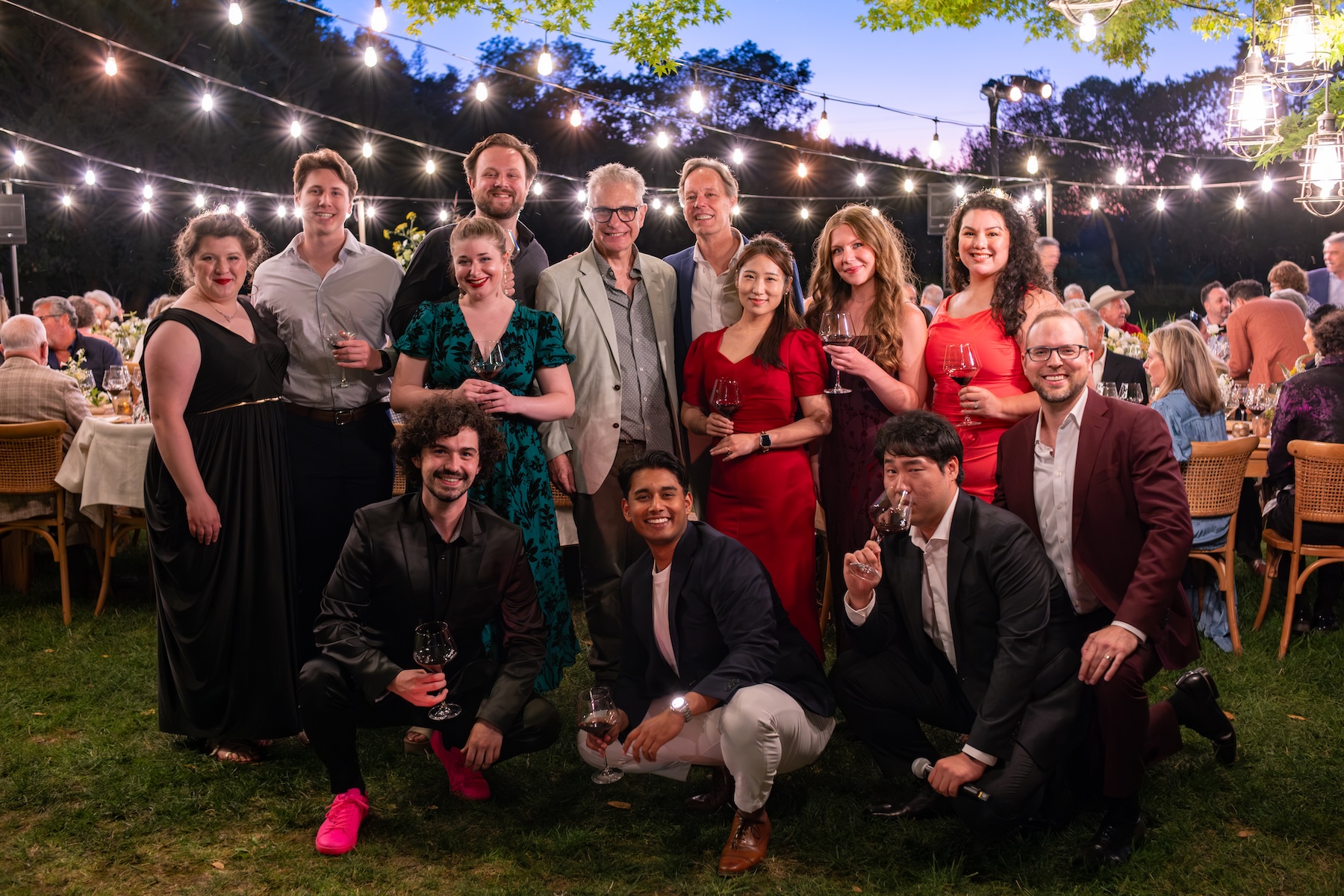 Within months, Gene delivered a libretto rich in humor, reverence, and emotional depth, while Jake’s music soared to Olympian heights.
“Wine and opera — a pairing made in heaven!” Jake said. “I’ve had the time of my life writing The Judgment of Paris and collaborating with this brilliant creative team. It’s a joyful story that set my creative spirit ablaze.”
Gene added, “Wine is inseparable from romance and celebration, the very lifeblood of opera. In this story, gods and mortals collide as they learn to respect tradition while daring to take risks and create anew.”
The production reunites conductor Kent Nagano and director Jean-Romaine Vespirini, alongside an all-star cast: soprano Danielle de Niese as Venus, baritone Quinn Kelsey as Bacchus, tenor Nicholas Phan as Steven Spurrier, mezzo-soprano Simone McIntosh as Patricia Gallagher, and soprano Brenda Rae as Odette Kahn. Fellows from the Manetti Shrem Opera Program portray Napa’s pioneering vintners and the fateful French judges.
“This opera captures the essence of Napa Valley — curiosity, courage, and the joy of discovery,” Charles said. “It unites artistry, history, and innovation into something truly timeless.”
And, by Zeus, it’s destined to be one for the ages.
World Premiere: The Judgment of Paris
Opera by Jake Heggie & Gene Scheer
Saturday, July 18, 2026 at 6:30pm
Festival Napa Valley Stage at Charles Krug